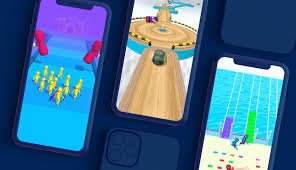
There was a time — and not too long ago — when mobile gaming felt complicated. Heavy downloads, long tutorials, steep learning curves. Then suddenly, almost out of nowhere, hyper-casual games took over.
You know the kind. Tap to jump. Swipe to move. No instructions needed. You open the app, play for 30 seconds, maybe a few minutes, and you’re done. It’s oddly addictive in a low-effort way — like scrolling through short videos, but interactive.
But now, the buzz around hyper-casual games feels a little quieter. Not gone, just… less noisy. Which raises a fair question: what’s actually happening here?
What Made Hyper-Casual Games So Popular?
At their peak, hyper-casual games were everywhere. They dominated app store charts, flooded ads across social media, and reached millions of users globally.
The formula was simple — minimal design, instant gameplay, and no barriers to entry. Anyone with a smartphone could pick one up and start playing within seconds.
For developers, it was a goldmine. Low production costs, quick development cycles, and massive user acquisition through ads. It wasn’t about building a long-term gaming experience; it was about scale.
And for players? It was easy entertainment during small pockets of time — waiting in line, commuting, or just killing a few minutes before sleep.
The Shift We’re Seeing Now
Lately, though, things feel different.
User expectations have evolved. People still enjoy quick games, but they’re also looking for a bit more depth — progression, rewards, maybe even a sense of achievement.
At the same time, advertising costs have gone up. Acquiring users isn’t as cheap as it used to be, which affects the entire hyper-casual business model.
This brings us to a natural curiosity — Mobile gaming me hyper-casual games ka future kya hai?
It’s not disappearing, but it’s definitely changing shape.
From Hyper-Casual to Hybrid-Casual
One of the most noticeable trends is the rise of hybrid-casual games.
These games still retain the simplicity of hyper-casual mechanics but add layers — like levels, upgrades, or basic storytelling. It’s a subtle shift, but an important one.
Players get the instant gratification they’re used to, along with a reason to come back.
Developers, in turn, get better retention and more monetization options beyond just ads — like in-app purchases or rewards systems.
It’s a middle ground that seems to be gaining traction.
The Monetization Challenge
Hyper-casual games traditionally relied heavily on ads — interstitials, rewarded videos, banners. And while that worked for a while, it also led to fatigue.
Too many ads can break the experience. Too few, and the revenue drops.
Balancing this has become increasingly difficult, especially as users grow more sensitive to interruptions.
Some developers are experimenting with alternative models, but it’s still a work in progress.
Creativity Still Has Room
Despite the challenges, one thing remains true — simplicity can still be powerful.
A well-designed hyper-casual game can still go viral. The barrier to entry is low, which allows new developers to experiment and innovate without massive budgets.
In a way, hyper-casual gaming democratized mobile game development. It showed that you don’t need a blockbuster idea — sometimes, a clever mechanic is enough.
And that spirit hasn’t gone away.
The Role of Data and Trends
Modern game development is deeply data-driven.
Developers test multiple concepts quickly, analyze user behavior, and scale the ones that show promise. Hyper-casual games fit perfectly into this model because they’re quick to build and easy to iterate.
But this also means the market can feel repetitive. Similar ideas, slightly different executions.
Standing out now requires more than just a simple mechanic — it needs a twist, something memorable.
Are Players Moving On?
Not entirely.
Hyper-casual games still serve a purpose. They’re perfect for short, low-commitment play sessions. Not every gaming moment needs to be immersive or story-driven.
But yes, players are exploring other formats too — casual, mid-core, even competitive games. The ecosystem is expanding, and attention is being divided.
Which isn’t necessarily bad. It just means hyper-casual games are no longer the only option.
Final Thoughts
The story of hyper-casual games isn’t one of rise and fall — it’s more about evolution.
What started as ultra-simple, ad-driven experiences is slowly transforming into something more nuanced. Not overly complex, but a bit richer, a bit more engaging.
And maybe that’s the natural path of any trend. It grows, peaks, adapts, and finds a new balance.
Hyper-casual games might not dominate headlines the way they once did, but they’re far from irrelevant. They’re just… growing up in their own way.
And honestly, that’s more interesting than a quick rise and fall.